

This game is included in the additional "Global Campaign" Distant Galaxy (9 stages).
Episode 7 - Asteroid Belt - standalone game.
historical background.
162 year after creation of the UC.
While the Aboriginal fleet has gone for their native sectors of the galaxy to lick their wounds, all Civilizations began to develop abandoned territories with redoubled zeal (what if the owners return again with new arguments?). The former unanimity dissipated, and each Civilization again began to pursue exclusively national interests, increasing their own wealth and sometimes hindering others.
This is a separate game related to the general plot, but it has different rules, playing field and chips. You have to move among a large number of asteroids and build mines on large asteroids to extract resources. At the same time, your competitors will be doing the same, so there may be conflicts of interest. Well, at the same time you have to deal with the remnants of Aboriginal enginery.
Players can participate in this scenario of Purple Federation, Orange Empire, Green Anarchy.
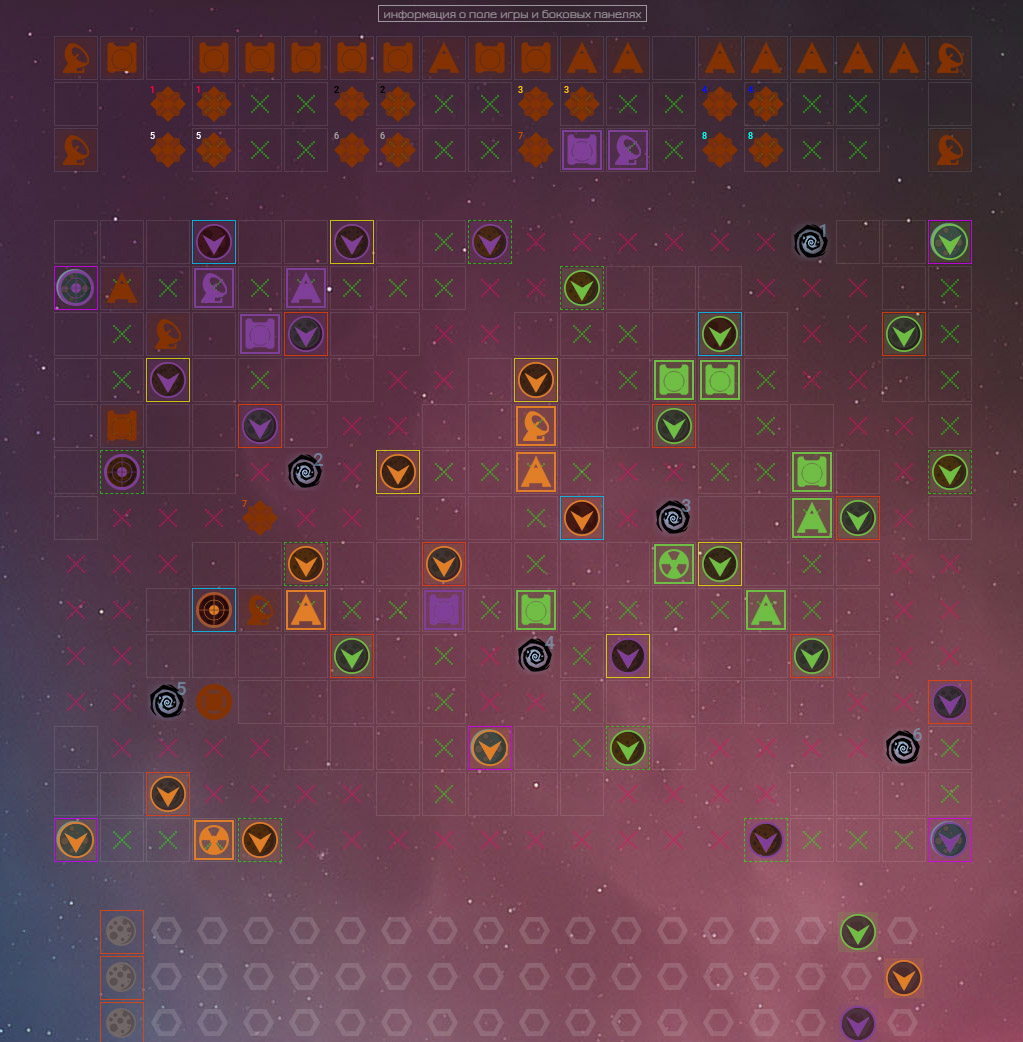
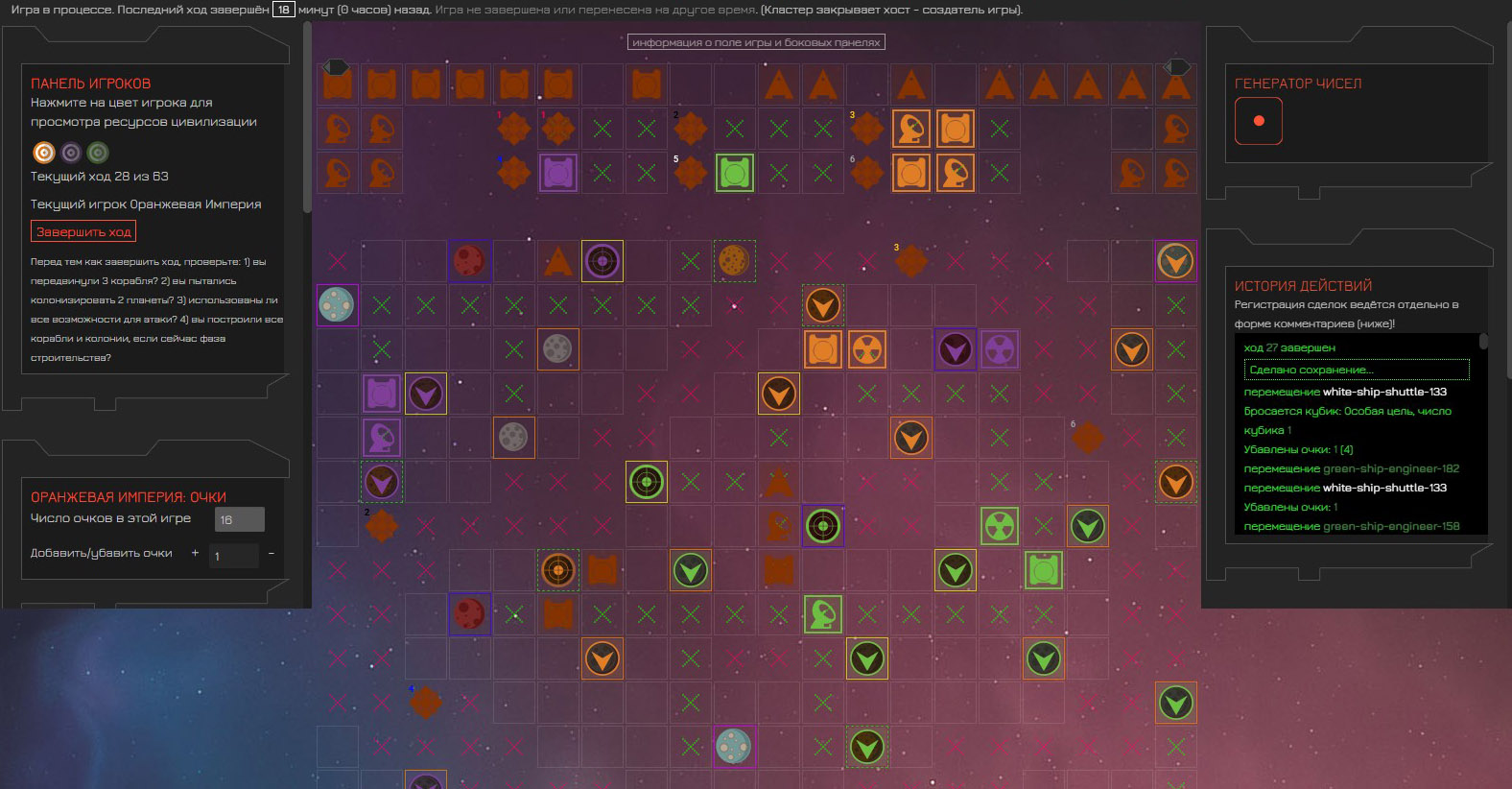
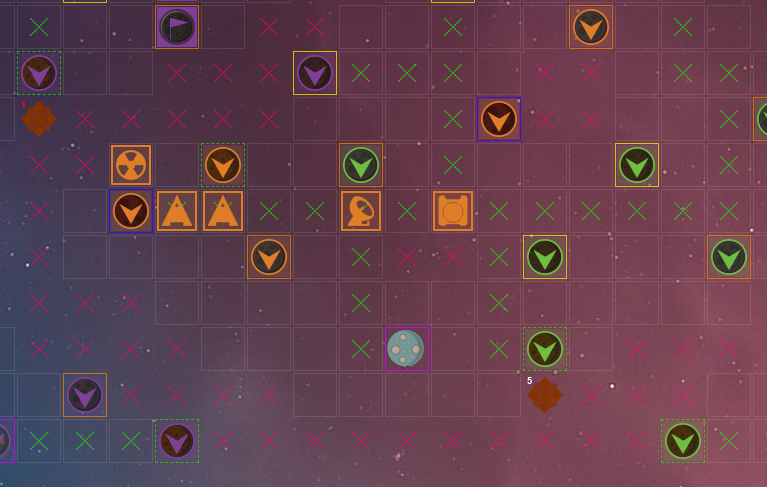
http://distant-galaxy.space/en/mods/171-stage-7-asteroid-belt.html#sigProIdaf6f7e796f
Purpose of the game - master a certain number of asteroids by building mines there and taking the available resources. There is a scale of achievements on the field, each time you explore an asteroid, you move the scale mark forward in accordance with the number of points that this or that asteroid gives.
As soon as one of the players reaches the extreme value of the scale, he becomes the winner.
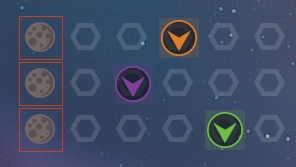
Asteroid classes.
The higher the class of the object, the more difficult it is to master, but the more resources and victory points.
|
|
Class 1. Red border. The number of victory points - 1. The number of resources received when capturing - 15. Defenders of the asteroid (brown chips) - 1 engineering squad. The total number of asteroids of this class on the standard game board - 10. |
|
|
Class 2. Yellow border. The number of victory points - 2. The number of resources received when capturing - 25. Defenders of the asteroid (brown chips) - 1 assault squad. The total number of asteroids of this class on the standard game board - 6. |
|
|
Class 3. Green border. The number of victory points - 2. The number of resources received when capturing - 25. Defenders of the asteroid (brown chips) - 2 engineering squads. The total number of asteroids of this class on the standard game board - 8. Important feature - near this object, you can create a shuttle to quickly move around the field (regardless of whose asteroid it is). However, if the asteroid is yours, you don't need to pay resources to build the shuttle. |
|
|
Class 4. Blue border. Number of victory points - 3. The amount of resources received when capturing - 35. Defenders of the asteroid (brown chips) - 1 engineering squad and 1 reconnaissance squad. The total number of asteroids of this class on the standard game board - 4. |
|
|
Class 5. Purple border. The number of victory points - 4. The number of resources received when capturing - 45. Defenders of the asteroid (brown chips) - 1 assault squad and 1 reconnaissance squad. The total number of asteroids of this class on the standard field of play is 5 (2 or 3 in the corners of the field are used at the beginning of the game as a starting base and do not give points). Important feature - each turn the asteroid gives +2 resource points. |


Capturing asteroids and building mines
In order to master the asteroid, you need to move your troops to it and overcome the resistance of the remaining Aboriginal enginery.
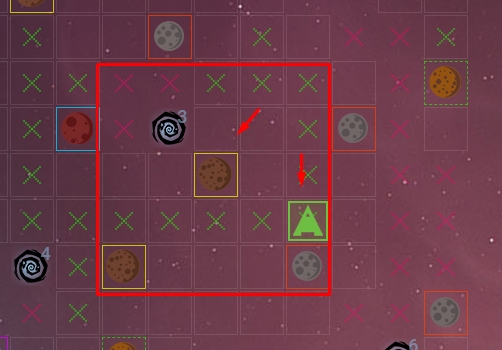
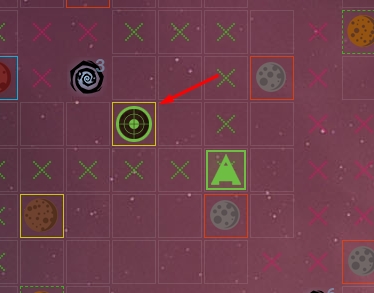
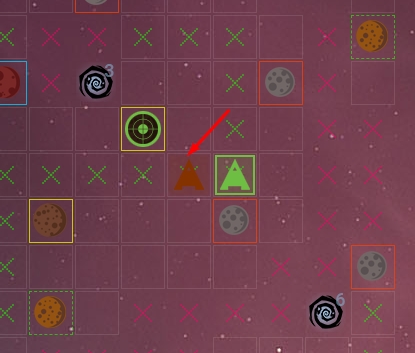
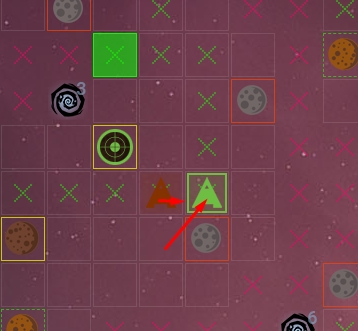
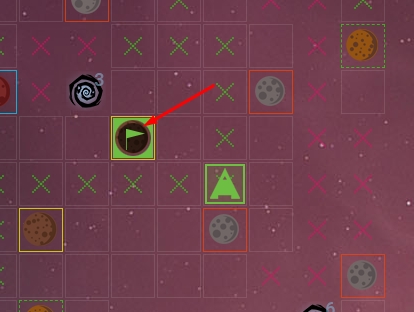
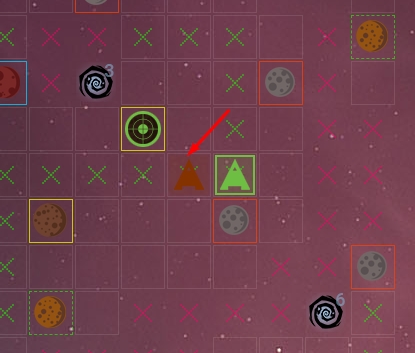
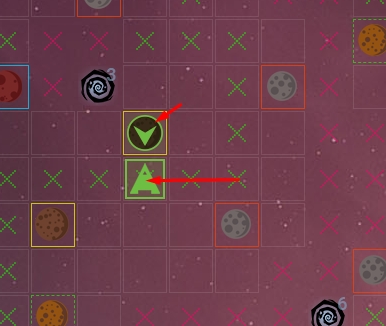
The process of mastering the object along with explanatory illustrations:
- You need to bring your squad closer to the object (within a radius of 2 cells around it)
- Putting the "Target" chip on an asteroid - this means that this player has the intention to capture it
- After the completion of a player's turn, the next player searches the map for the previous player's target chips and sets up asteroid guards.
- Asteroid guards (controlled by the next player) attack the invading invaders
- If the guard is defeated, the target chip is changed to a "Flag" chip.
- If the guard wins or there is a tie, the units stay where they are until the attacking player's turn.
- Attention - in order to receive a reward (victory points and resource points), you need to make a move with your unit near the defeated object and change the flag chip to the "Mine" chip. The competitor may also do so by claiming victory.!
http://distant-galaxy.space/en/mods/171-stage-7-asteroid-belt.html#sigProId254281e9a2
Note - according to the rules of this game, another player can no longer take away a mine built.
You can remove another player's goal chip and place your own.
Types of units on the field of play
In total, the game has 4 types of units participating in battles and 2 types of Aboriginal chips for additional purposes.
|
|
Engineering unit. Base unit of Civilizations. Speed: 2 cells. Resource consumption: 1 per move. Crafting cost: 10 resource points. Attack bonuses: none. Aborigines have similar units of this class. |
|
|
Assault unit. Faster and stronger unit. Speed: 4 cells. Resource consumption: 2 per movement. Crafting cost: 20 resource points. Attack Bonuses: +1 Attack and Defense. Aborigines have similar units of this class. |
|
|
Reconnaissance unit. Unit for more effective attacks. Speed: 2 cells. Resource consumption: 1 per move. Crafting cost: 20 resource points. Attack bonuses: can attack one cell away from the enemy, diagonally close, and close to enemy without risk to himself (no bonuses when defending). Aborigines have similar units of this class. |
|
|
Elite unit. Particularly important unit in the singular. Speed: 3 cells. Resource consumption: 0 - not required (own powerful energy source). Cost to create ("resurrect"): 40 resource points. Attack bonuses: +1 to attack and defense. Unique abilities. An elite unit comes with 3 opportunity chips (shown in the illustration). Chips are kept in reserve, not on the field. They can be used once (by moving to "repair") in the following cases:
Also, if the elite is next to the mine of their color, you can create certain units near it by spending resources from the reserves. Aboriginals Dont Have similar units of this class. |


Aboriginal shuttles
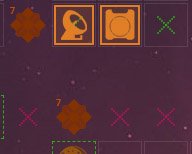
Regular shuttle. The shuttle can only be used to quickly move around the red squares of the field (it is difficult areas for navigation). The shuttle can accommodate up to 3 units. Resources are not wasted when moving. Movement speed is determined by a die - from 1 to 6.
Can be used to pass through portals.
Activation and loading of units. The shuttle can be activated while near a class 3 asteroid (green dotted cell border). To do this, you need to spend 3 resource points. On the field you see 2 shuttles of the same color and number. One shuttle moves to the field, the second simply indicates which units are loaded into it. Units load by moving into the space of the shuttle (in this case, the chips actually move to the upper section of the shuttle outside the playing field). When loading, you can conditionally skip the cell class 3 asteroid (+1 speed). Unloading works in the same way.
If there are no more units in the shuttle, it is removed from the field back to the upper section.

Cargo shuttle.Units do not move in it, it contains stocks of resources that can be stolen with some degree of probability. At the start of the game, a die is rolled to determine which portal the shuttle will be in. On each attack attempt, the shuttle randomly changes the portal (regardless of the result of the attack).
To attack him, you need to get close with your shuttle and roll the die. Probability of an event outcome:
| Number on the dice | Result |
| 1 | defeat of the attacking shuttle (chips for repairs) |
| 2 |
if there is 1 squad in the shuttle - defeat of the attacking shuttle (chips for repairs) if there are 2 or 3 squads in the shuttle - the cargo shuttle escapes the chase into another portal |
| 3 | the cargo shuttle escapes the chase into another portal |
| 4 | the cargo shuttle escapes the chase into another portal |
| 5 | you get 30 resource points |
| 6 | you get 40 resource points |
Movement on the field
At the edges of the field there are 3 class 5 asteroids - Civilizations place their chips on them and start from these points, sending their units one by one from there. Players can use all units available in the reserve. Losing units are sent to the "repair" section and from there they can return to the field in 2 cases:
- After the development of the asteroid and the construction of the mine, the squad can be placed near the mine, if the resources obtained from this particular mine allow it.
- If there are resources in reserve, the squad can be created at the starting base, but then it will have to be moved to the destination from the starting mark
Logistics (number of units moved) is not limited. You can move as many units as the accumulated resources and free cells on the path of movement allow (only 1 chip can be on one cell).
You can move either before or after the attack. If one of your units occupies the desired cell and interferes with the movement and achievement of goals, it can be eliminated.
There are several types of cells on the field, the rules of movement:
| Cell type | Opportunities for movement |
| cells with a green mark | highways between asteroids, along which ordinary units can move |
| cells with a red mark | only shuttles can move on them |
| empty cells without marks | Aboriginal units and elite units of Civilizations can move on them |
| asteroids | You can't place a unit or a shuttle on this cell, but you can just cross it |
| portals | You can't place a unit or a shuttle on this cell, but you can just cross it |
Conflicts
Conflicts can be directly between the players themselves and with the Aboriginals in an attempt to explore asteroids. The Aboriginal units are played by players whose turn is the next after the initiator of the attack on the asteroid. That is, player 2 moves Aboriginal chips against player 1, player 3 moves the Aboriginal chips against the player 2, player 1 moves Aboriginal chips against player 3,
Aborigines occupy an area within a 1 cell radius of the asteroid when attacked.
Unlike the regular "Distant Galaxy" game, the outcome of a battle is almost always decided by a die roll. Explanations:
- player 1 rolls attack number (rolls 6), player defense 2 (rolls 4), player 1 wins
- player 1 rolls attack number (rolls 2), player defense 2 (rolls 5), player 1 is defeated and removes his chip
- player 1 rolls attack number (rolls 3), player defense 2 (rolls 3), draw, both units remain on the field
- assault and elite units have +1 attack and defense bonus
You can attack by coming close to the enemy horizontally or vertically,only scouts can attack diagonally and through 1 cell.
You can also attack the shuttle with another shuttle, if there are more units in one shuttle, then it has +1 to attack and defense.
Resource usage
The print version of the game has score chips, the web version uses a scoring block. At the beginning of the game, everyone is given 30 points. Resource points are spent on moving units and creating them (also on activating shuttles). With each successful construction of the mine, resources are replenished. The resources obtained can be set aside or immediately used to create units right next to the mine. You can set aside some and use some on units.
Differences between Civilizations
Bonuses of the Orange Empire.
+1 to the number of assault troops at the start of the game. 15% discount on the creation of assault squads (instead of 20, you need 17 units of resources). Also, an elite unit can create attack aircraft near the mine where it is located (only this type of unit, 1 unit per turn). Created unit can be used in another turn.
Purple Federation Bonuses.
+1 to the number of reconnaissance units at the start of the game. 15% discount on the creation of reconnaissance units (instead of 20, you need 17 units of resources). Also, an elite unit can create scouts near the mine where it is located (only this type of unit, 1 unit per turn). The created unit can be used immediately.
Green Anarchy Bonuses.
+1 to the number of engineer units at the start of the game. 20% discount on the creation of engineering units (instead of 10, you need 8 units of resources). Also, an elite unit can create engineers near the mine where it is located (only this type of unit, 1 unit per turn or 2 units (dice roll and result from 4 to 6)). The created unit can be used immediately.
Additional notes
If the player has run out of all units and has no resources to create them, the player can request one-time reinforcements to the starting base. He can get 1 unit of all types and 20 resource points.
Fast Game - 4 points at the start of the game (starting base gives victory points).
Hard game - minus 5 resource points for each asteroid and inactive Aboriginal cargo shuttle.